OptimAI Architecture
OptimAI is built around a simple product architecture:
- Search provides live, source-backed context.
- Claw turns context into execution.
- Persona Agent gives agents user-approved memory and identity.
- Nodes supply data access, validation, compute, bandwidth, and execution capacity.
- Marketplace, OPI, and OptimAI Chain coordinate distribution, access, reputation, and rewards.
This page explains how those parts fit together.
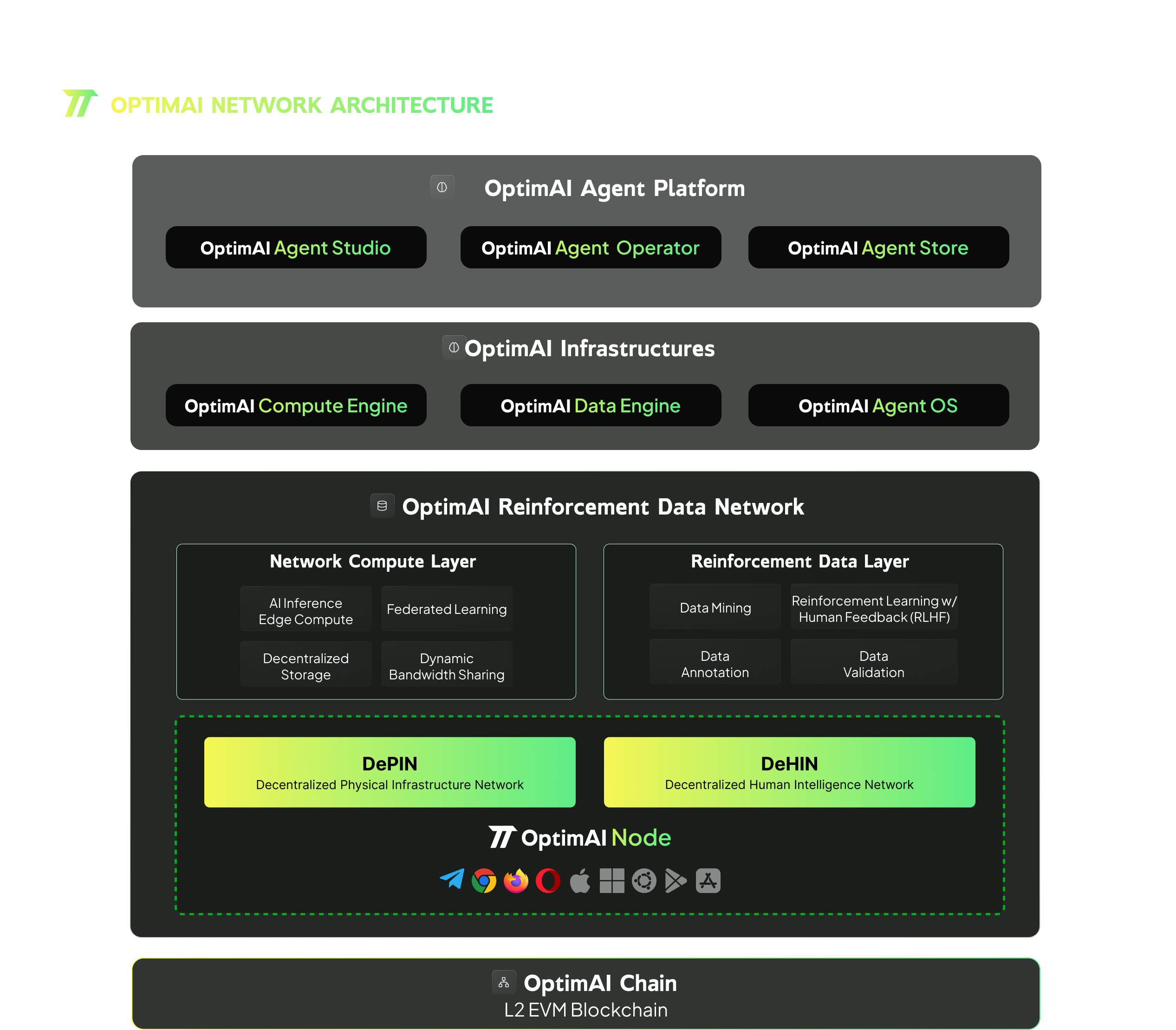
Architecture Summary
OptimAI separates the system into three concerns:
- Product composition: Search, Claw, Persona, APIs, MCP, x402, and Marketplace.
- Service execution: Agent, Data, Compute, Network, and Trust engines.
- Network coordination: nodes, validators, reinforcement data, OPI, reputation, and governance.
This separation matters because agent systems become fragile when retrieval, execution, memory, data quality, and incentives are mixed together without clear boundaries.
Layer Model
| Layer | Role | Main components |
|---|---|---|
| Product layer | User and builder surfaces. | OptimAI Search, OptimAI Claw, Persona Agent, APIs, MCP, SDKs |
| Agent layer | Plans, remembers, retrieves, extracts, acts, and learns from feedback. | task planners, memory, tool routing, workflow state |
| Service layer | Turns product requests into data, compute, trust, and network tasks. | Agent Engine, Data Engine, Compute Engine, Network Engine, Trust Engine |
| Reinforcement data layer | Converts raw signals into trusted AI context. | mining, parsing, validation, provenance, quality scoring, feedback |
| Node layer | Runs distributed work. | Lite Node, Core Node, Edge Node, CLI Node, Telegram Node, validators |
| Coordination layer | Tracks contribution, distribution, and value flow. | Marketplace, OptimAI Chain, OPI, rewards, staking, governance |
Architecture Planes
A production-grade agent network needs clear separation between product experience, execution, trust, and value flow.
| Plane | What it owns | Why it matters |
|---|---|---|
| Experience plane | Search UI, Claw workflows, Persona profiles, builder tools. | Gives users and developers coherent product surfaces. |
| Execution plane | Core Node runtime, CLI Node, task orchestration, Claw jobs, compute workloads. | Moves agents from responses to real workflow execution. |
| Data plane | source ingestion, parsing, embeddings, extraction records, memory objects, datasets. | Keeps agent context structured and reusable. |
| Trust plane | provenance, freshness, validation, reputation, feedback, permission rules. | Makes outputs inspectable instead of opaque. |
| Economic plane | OPI rewards, marketplace payments, campaigns, staking, governance. | Aligns contributors, builders, users, and the protocol. |
Control Flow vs Data Flow
OptimAI separates the control flow that decides what should happen from the data flow that carries source material, records, memory, and outputs.
| Flow | Description | Examples |
|---|---|---|
| Control flow | Plans, policies, permissions, routing, retries, and settlement. | Agent Engine, Trust Engine, Network Engine, OPI reward events |
| Data flow | Sources, chunks, embeddings, extracted fields, citations, memory, datasets. | Data Engine, Reinforcement Data Network, Persona memory, Claw records |
Keeping these separate makes the system easier to inspect. A user should be able to ask both “what did the agent use?” and “why was it allowed to use it?”
End-To-End Flow
Product Roles
Search: Context Layer
Search gives agents current context from the open web, social sources, indexed data, and network-refreshed sources. It is not only a search box; it is the retrieval surface that other OptimAI products can call when they need source-backed information.
Claw: Execution Layer
Claw is the native agent runtime inside the Core Node environment. It can take a goal, plan subtasks, gather context, extract structured records, generate reports, and carry a workflow closer to completion.
Persona Agent: Memory Layer
Persona Agent stores user-approved preferences, projects, workflows, source lists, and decisions. It gives agents continuity without forcing users to repeat the same context every session.
Nodes: Infrastructure Layer
Nodes provide the distributed network behind the products:
- Lite Node: low-friction participation through browser extension and Telegram.
- Core Node: desktop and CLI execution for Claw, browser-native workflows, extraction, compute, and campaign tasks.
- Edge Node: mobile participation and future local-context workflows.
Service Responsibilities
| Service | Responsibility |
|---|---|
| Agent Engine | Plan workflows, route tools, maintain state, and coordinate Search, Claw, Persona, and APIs. |
| Data Engine | Parse, clean, normalize, embed, enrich, package, and route data for validation. |
| Compute Engine | Assign processing, embeddings, inference support, and campaign workloads to eligible resources. |
| Network Engine | Coordinate nodes, task routing, bandwidth, health, reliability, and secure communication. |
| Trust Engine | Apply permission checks, provenance requirements, freshness thresholds, validation policy, and quality scoring. |
For a deeper service-level breakdown, see OptimAI Services.
Builder Interfaces
OptimAI exposes the network through developer surfaces that match the product stack:
| Interface | Purpose |
|---|---|
| Search MCP | Let MCP-compatible agents use OptimAI Search as a live context tool. |
| Search API | Add source-backed retrieval to products and backends. |
| x402 SDK | Build paid, agent-native search flows with payment-aware requests. |
| Claw preview jobs | Model extraction, monitoring, and workflow execution contracts. |
| Persona preview memory | Model user-approved memory objects for agent personalization. |
| Schemas | Standardize sources, citations, Claw records, Persona memory, campaigns, node capabilities, and reward events. |
Trust Model
OptimAI should treat trust as a data property, not a marketing claim. Useful outputs need:
- source URL or origin
- capture timestamp
- node or workflow metadata
- extraction method
- validation status
- freshness score
- quality score
- user or validator feedback where relevant
Architecture Guarantees To Aim For
These are design targets for a mature OptimAI system:
| Guarantee | Meaning |
|---|---|
| Inspectable output | Users can see sources, citations, memory use, and validation status where relevant. |
| Permissioned execution | Sensitive data and authenticated sources require explicit policy checks. |
| Portable context | Search results, Claw records, Persona memories, and datasets use consistent object models. |
| Composable tools | Search MCP, APIs, x402, Claw jobs, and Persona memory can be combined in agent workflows. |
| Rewardable contribution | Accepted node and validator work can produce reputation and reward signals. |
Why The Architecture Matters
Most AI products fail at the handoff: they can summarize, but not execute; retrieve, but not remember; answer, but not verify; personalize, but not give users control. OptimAI connects those missing parts into one network.
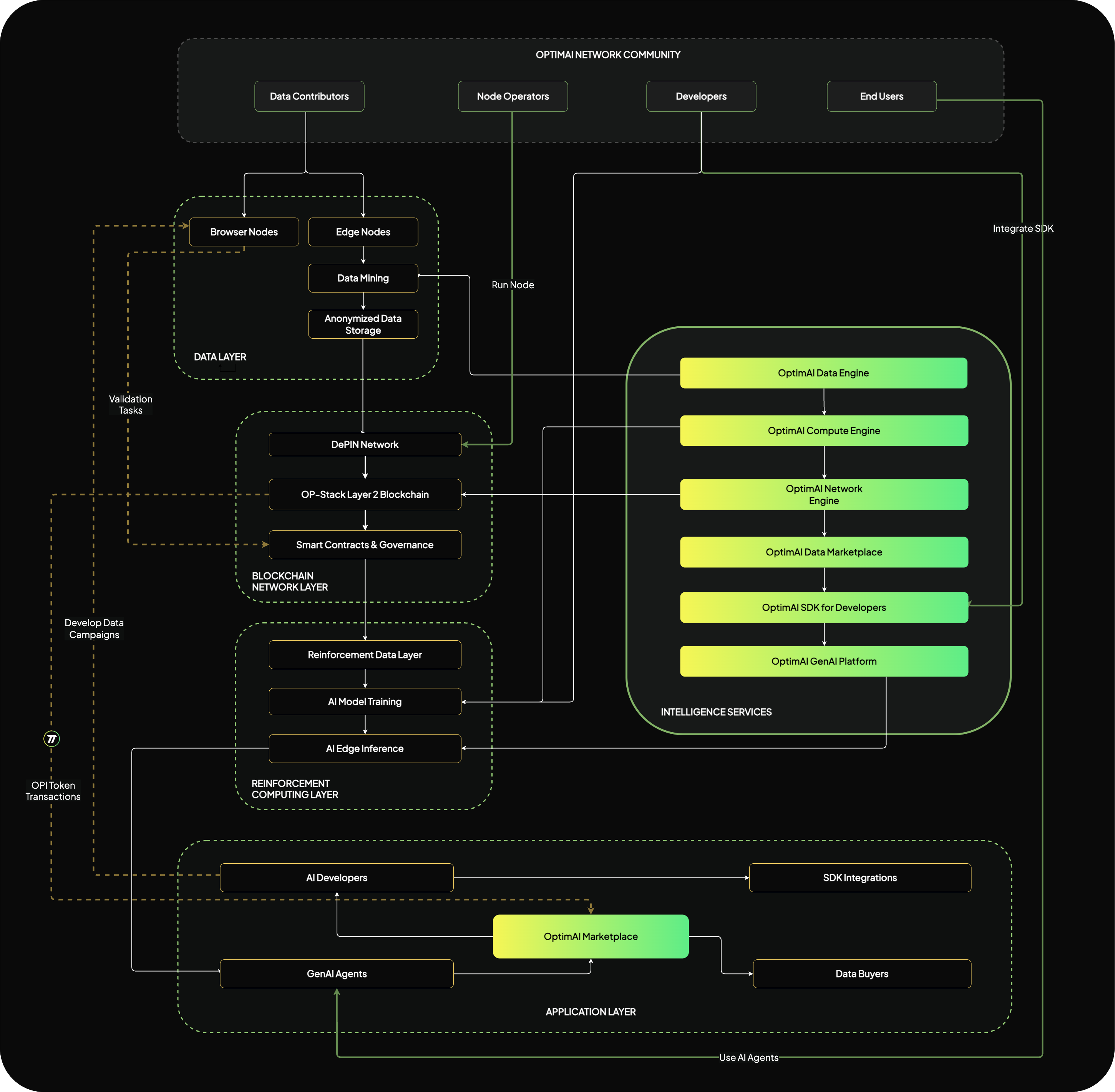
Design Principles
- Current context: Agents need live data, not stale snapshots.
- User control: Permissioned sources and personal memory should stay under user control.
- Provenance by default: Important outputs should show where they came from.
- Composable products: Search, Claw, and Persona should work separately and together.
- Network-aligned incentives: The people who contribute useful data, compute, and validation should be rewarded.
- Graceful maturity: Production interfaces should be stable; preview interfaces should be clearly labeled until contracts are final.